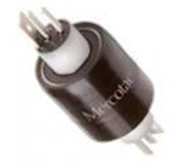
Detail AUTOGARD TORQUE LIMITER SERIES 600
AUTOGARD SERIES 600
Quality and Autogard are synonymous with overload protection. The Company' s reputation for high
quality products is derived from over 40 years of design, innovation and production. Autogard products
are manufactured to meet ISO 9001 using the latest machine tools and high quality materials.
D
A
E
F
C
B
2
The specifications contained within this brochure are correct at the time of going to print. Autogard is continually reviewing and updating the
specifications on all its product ranges and therefore reserves the right to change any details.
The drive is transmitted through balls ' A' held in detents
' B' in opposing plates ' C' by adjustable air pressure
acting on a large annular piston or a number of small
pistons depending on the torque required.
The air cylinder / piston assembly ' D' is separated from
the rotating drive plate / adapter ' E' and plates by two
deep groove ball bearings ' F' . This allows air to be
supplied radially for shaft to shaft and line shaft
applications and gives a long maintenance free life.
As a Disengaging Clutch
When required to act as a disengaging clutch, the air is
dumped at the press of a button, the balls roll out of the
seats without skidding to disengage the drive, and the
plates are held apart by spring pressure so that no drive
is transmitted by the coupling. Two more ball bearings
are provided between the hub and main drive plate /
adapter to give a completely free running clutch.
As a Torque Limiter
The overload protection for the drive is provided by
the same mechanism. The supply air pressure may
be set in the range 1.35 - 5.4 Bar ( 20-80 psi) to give
the precise overload torque requirement using a
pressure regulator. This can be done manually
during normal running to take account of changing
loads, or automatically using a dual regulator system
with a timer or other control. This allows high start
torque to be accommodated before switching to a
lower running torque. When the torque setting is
exceeded, the balls begin to roll out of their seating,
forcing plates apart against the air pressure. This
motion operates a pneumatic limit switch which
' dumps' the air pressure, disengages the clutch and
releasing the drive from the overloaded machine.
Re-engagement is effected in both cases simply by
operating a Push Button Initiating Valve. Rotation of
the drive at slow speed will then engage the clutch.
Tampilkan Lebih Banyak